Sarajevo, 30 October 2026
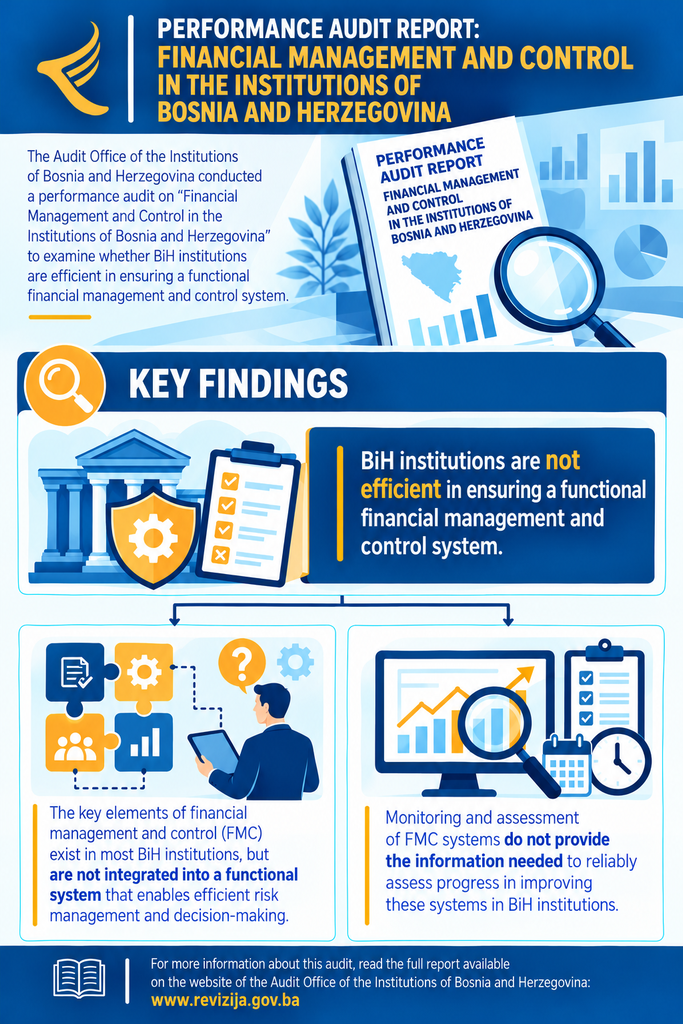
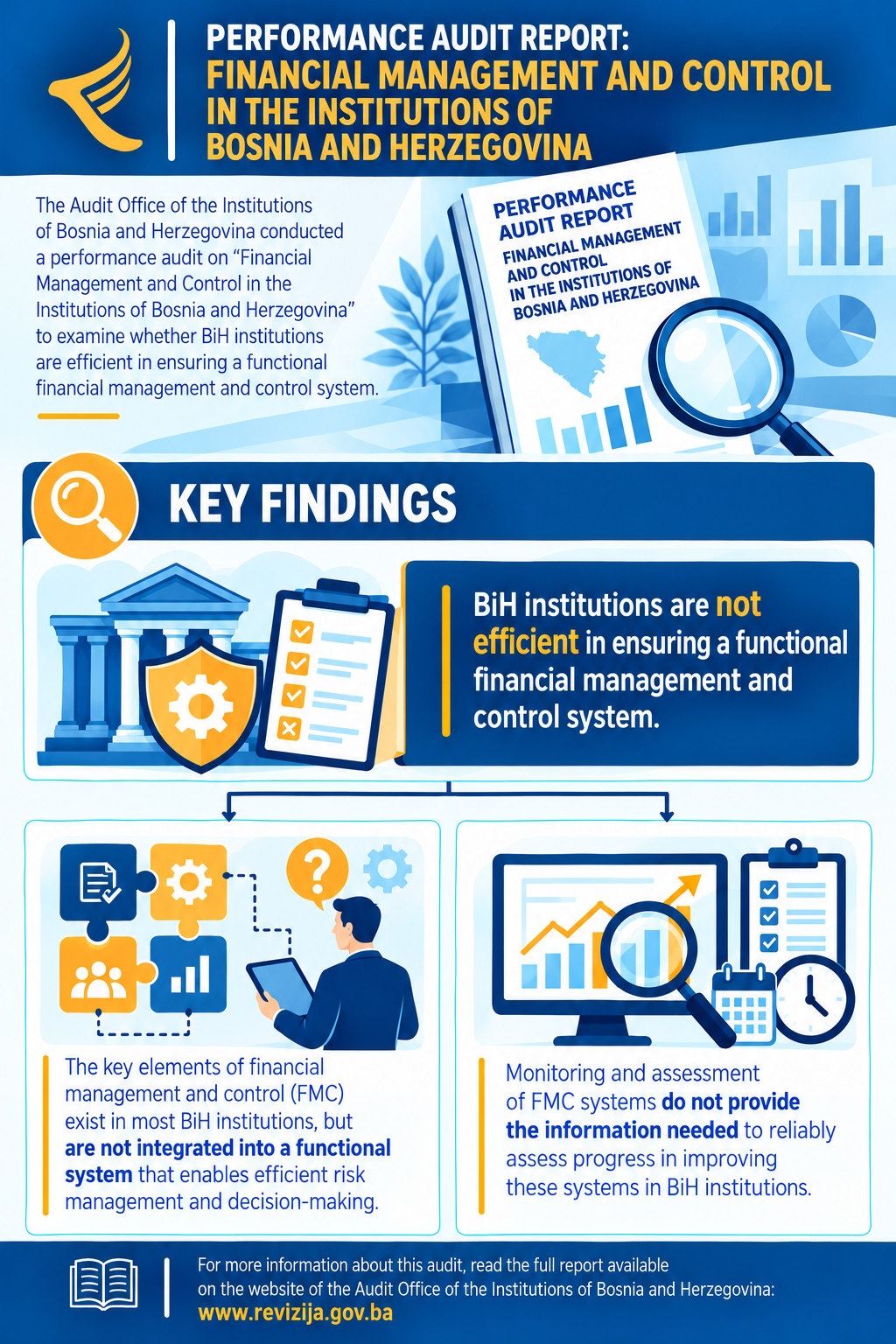
The institutions of Bosnia and Herzegovina are not efficient in ensuring the establishment, implementation and operation of financial management and control systems.
Although they have established the key elements of financial management and control (FMC) systems, these elements are not sufficiently interconnected or used in a way that ensures that FMC systems provide reliable support for risk management and decision-making.
The Central Harmonisation Unit of the Ministry of Finance and Treasury of Bosnia and Herzegovina has not ensured sufficiently efficient monitoring and assessment of the quality of financial management and control systems in BiH institutions.
These are the key findings of the performance audit “Financial Management and Control in the Institutions of Bosnia and Herzegovina”, conducted by the Audit Office of the Institutions of Bosnia and Herzegovina. Among other findings, the audit showed that:
- Responsibilities for financial management and control are not clearly defined in all internal organisation rulebooks.
- Institutions do not regularly update their business process maps and risk registers.
- The planning of measures to improve the systems and the monitoring of their results are insufficiently developed.
- Information on risks and measures implemented is not sufficiently used in decision-making.
- The PIFC application, designed to support financial management and control, has functional limitations.
- Quality assessments do not provide a complete picture of how the systems operate in practice.
- It is not possible to reliably determine the extent to which implemented recommendations have contributed to improvements in the systems.
The Audit Office issued recommendations to BiH institutions and the Central Harmonisation Unit to:
- define responsibilities more clearly and improve the links between key system elements;
- improve risk identification and monitoring;
- improve the monitoring of system quality and the results of measures implemented;
- address limitations in the functionality of the PIFC application.
Implementing these recommendations should help BiH institutions manage risks better, make better decisions and use public funds more efficiently.
Further information on the audit findings, conclusions and recommendations, as well as the full report, is available on the Audit Office’s website: www.revizija.gov.ba.